(from FABIOLALLI.com)
Negli ultimi anni la nostra realtà quotidiana è stata intrisa di tecnologia che ha tessuto una rete complessa e sfaccettata che sfida continuamente le nostre tradizionali percezioni di spazio, tempo e interazione. In questo contesto emergente, concetti come realtà virtuale (VR), realtà aumentata (AR), realtà mista (MR), realtà estesa (XR) e, più recentemente, Hyper Reality, non sono solo diventati argomenti di fervida discussione tra i tecnologi, sociologi, filosofi, ma hanno anche aperto nuove frontiere di esperienza e possibilità per l’utente medio che comincia a vedere questi temi come più comuni, anche se non ancora pervasivi e di massa.
Despite their increasing prevalence in our digital culture, the understanding of these terms and the distinction between their applications and potential remain shrouded in a fog of ambiguity and misunderstanding.
Scrivo questo articolo in risposta alle domande che ricevo spesso in classe, o dai clienti, e mi concentro un po’ di più su questi concetti, delineando non solo le loro definizioni ma esplorando anche il loro impatto sul tessuto della società moderna e sul potenziale futuro che ne deriva. ci aspetta. Come il mercato per
I start here, "But what is the difference between Augmented Reality, Virtual Reality and Mixed Reality? " and to answer it is correct to delve into each of these classifications, starting with a basic concept.
What is Reality?
Reality, as we know it, is a deeply personal and subjective concept, shaped by our experiences, perceptions and interpretations of the world around us. This concept of reality has been further complicated and enriched by the advent of digital technologies, which have introduced new levels of experience and perception. Virtual reality, augmented reality, mixed reality and extended reality are all expressions of how technology is challenging and rewriting the rules of human perception, offering new windows through which to observe and interact with the world.
The distinction between the physical and digital worlds is becoming increasingly blurred, with technologies allowing us to immerse ourselves in virtual environments indistinguishable from reality, enrich our physical environment with digital information and objects, or even create spaces in which the physical and digital coexist and interact. in ways previously unthinkable. The modern understanding of reality cannot ignore the influence of immersive technologies that, day after day, rewrite our sensory and cognitive experiences.
Delving into the Continuum Concept of Virtuality.
Il concetto di continuum di virtualità fornisce un quadro teorico fondamentale per comprendere il vasto panorama delle tecnologie immersive. Proposto originariamente da Paul Milgram e Fumio Kishino nel 1994, il continuum della virtualità esplora l’intero spettro di esperienze che si estendono dal mondo reale, completamente fisico, a quello completamente virtuale, offrendo una mappa per navigare tra le varie gradazioni della realtà mista. Questo spettro non è statico, ma dinamico, riflettendo la continua evoluzione della tecnologia e delle sue applicazioni nel mescolare elementi digitali e fisici.
All’estremità del continuum troviamo la realtà pura, non mediata da alcuna tecnologia digitale. Mentre ci muoviamo lungo il continuum, incontriamo la realtà aumentata, che sovrappone elementi digitali al mondo fisico, e la realtà mista, che consente un’interazione più profonda tra questi elementi. Proseguendo si arriva all’ambiente totalmente immersivo della realtà virtuale, dove il mondo fisico è sostituito da quello digitale. Questo modello ci aiuta a comprendere che le esperienze offerte da AR, MR e VR non sono entità isolate, ma parti di un fluido continuum della realtà, ciascuna con il proprio potenziale unico per trasformare la nostra interazione con il mondo.
What is Augmented Reality (AR)?
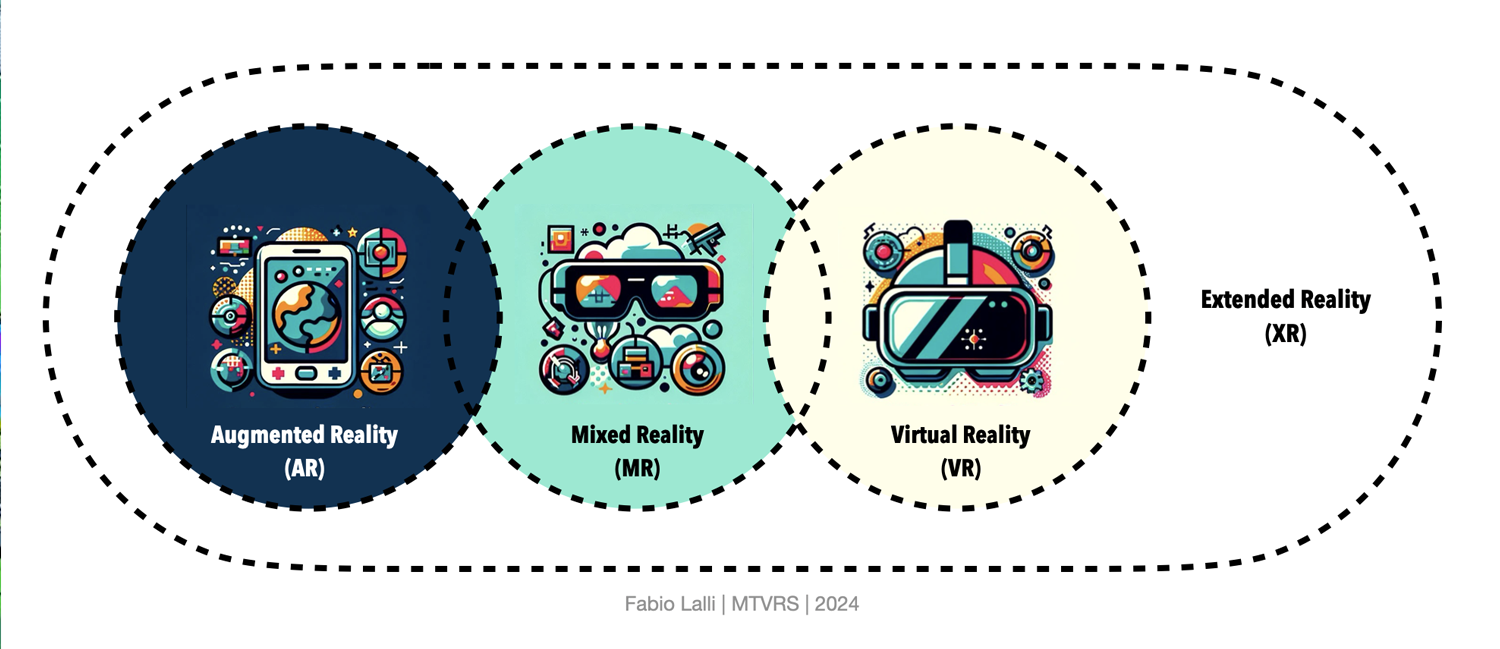
Augmented reality (AR) represents the technology that superimposes digital content-such as images, videos, or data-on the real world, thus enriching the natural visual experience with additional information perceived through devices such as smartphones, tablets, or specific viewers. Unlike virtual reality, which creates a completely artificial environment, AR enhances the existing environment without replacing it, keeping the user anchored in his or her physical context while interacting with digital elements.
The application of AR is wide and varied, ranging from entertainment to education, from industrial maintenance to marketing. In educational applications, for example, AR can transform a traditional textbook into an interactive experience, with images that come to life or 3D models that students can explore from different angles. In commerce, AR offers consumers the ability to view 3D products in their environment before making a purchase, enhancing the online shopping experience with a level of interaction and personalization previously inaccessible.
What is Virtual Reality (VR)?
he virtual reality (VR) transports the user into a fully generated/rendered world, creating an all-encompassing immersive experience that can simulate reality or transport into fantastic environments or real environments reproduced or recorded with 360 photos/videos. Unlike AR, which integrates and enriches the physical environment with digital elements, VR replaces the real world with a virtual space, isolating the user from the outside world and engaging all senses to produce a fully immersive experience. Users interact with the virtual world through devices such as VR visors, tactile gloves and motion tracking systems, or other systems that can enable additional dynamics (e.g., Disney's new Holotile carpet) and that together create the feeling of being physically present in the digital environment.
The use of VR ranges from entertainment and games, where it provides immersive and spectacular experiences, to education and training, where it can simulate complex or dangerous situations in a safe context. For example, pilots use VR simulators for flight or automotive training, allowing them to practice in various weather conditions and emergency situations without the risks associated with real-world dynamics. In the medical field, VR is being used for surgical training, rehabilitation and even for the treatment of psychological disorders, such as phobia and post-traumatic stress disorder, providing a controlled environment in which patients can face and work through their fears.
What is Mixed Reality (MR)?
Mixed reality (MR) goes beyond augmented reality and adds some of the potential of VR by integrating and overlaying virtual elements with the real world so that they interact dynamically with the physical environment. This means that digital objects placed in an MR space can be manipulated and can respond to changes in the real environment, creating an experience that combines the best of both worlds. Thus, MR represents a significant advancement in human-computer interaction, as it requires a deeper understanding and more sophisticated integration of physical and digital reality.
Applications of MR are particularly promising in fields such as design and engineering, where professionals can collaborate on virtual 3-D models superimposed on the real working environment, enabling unprecedented visualization and manipulation of designs under development. In education, MR can immerse students in interactive learning environments that stimulate both engagement and understanding, offering hands-on experiences in otherwise inaccessible or dangerous real-world settings.
What is Extended Reality (XR)?
Extended reality (XR) represents the concept that incorporates all forms of combined reality, from augmented reality (AR) and mixed reality (MR) to virtual reality (VR), and any other future technology that blurs the boundaries between the physical and digital worlds. XR is not limited to a single type of interaction or experience; rather, it embraces the full spectrum of environments that extend, enrich, or completely replace physical reality with a digital one. This term has become increasingly prevalent as immersive technologies have developed, reflecting their collective potential to create unprecedented experiences that can revolutionize areas such as education, entertainment, medicine, and commerce.
The importance of XR lies in its ability to seamlessly integrate digital information with the physical world, thereby enhancing our understanding and interaction with the reality around us. In particular, technologies such as Connectivity in Mobility, Artificial Intelligence, IOT and Wearable Techgnology are converging toward XR.
In education, students can explore virtual environments that reproduce historical events or simulate complex scientific phenomena, offering a level of immersion and interactivity that traditional teaching methods struggle to achieve. In healthcare, XR can assist surgeons by visualizing patient anatomy in 3D during surgeries, reducing the risk of errors and improving outcomes of operations.